

Nansha's application round runs to 31 December. Check the support category and evidence requirements before filing.
At a glance
- Applications: 1 November to 31 December 2026.
- An earlier policy, a current claim window.
- Submission is not payment.
A current window, not a new policy
The 29 October notice supplies the current guide. January-to-October salary and comprehensive subsidy claims must use this window; late or incomplete claims cannot be retrospectively made up. Living allowances and internships have separate instructions.
Check eligibility before preparing a claim
The guide covers Chinese nationals aged 45 or below, including Hong Kong and Macao permanent and non-permanent residents. Age is assessed on 1 January of the first application year. Employment and social-insurance conditions also apply.
What the underlying policy covers
The underlying policy was issued on 29 July and published on 4 August, rather than introduced this week. It sets salary support at 10% of monthly pay, capped at RMB3,000 a month, and internship support at RMB1,000 a month for up to six months. A separate RMB2,000 award goes to an eligible internship host, not to the intern. It also sets a conditional RMB20,000 start-up award after six months of actual operations. These are different support instruments, not a single guaranteed payment. The policy says item-specific conditions, documents, routes and deadlines are governed by the application guide. It also applies a higher-amount, no-duplication approach where relevant support overlaps. Applicants should therefore read the current guide alongside the older policy, rather than assume every headline amount can be added together.
Employment, enterprise and living support are different
The bureau's earlier official summary grouped the measures around employment, internships, entrepreneurship, integration and living support. That breadth matters when reading a headline about youth subsidies: a young employee, an internship host and a founder are not necessarily claiming the same award. The summary also describes differentiated living allowances for eligible degree holders. It is useful background to the policy's design, but it is not evidence that any particular person qualifies, that every category shares one submission route, or that a payment has reached a recipient.
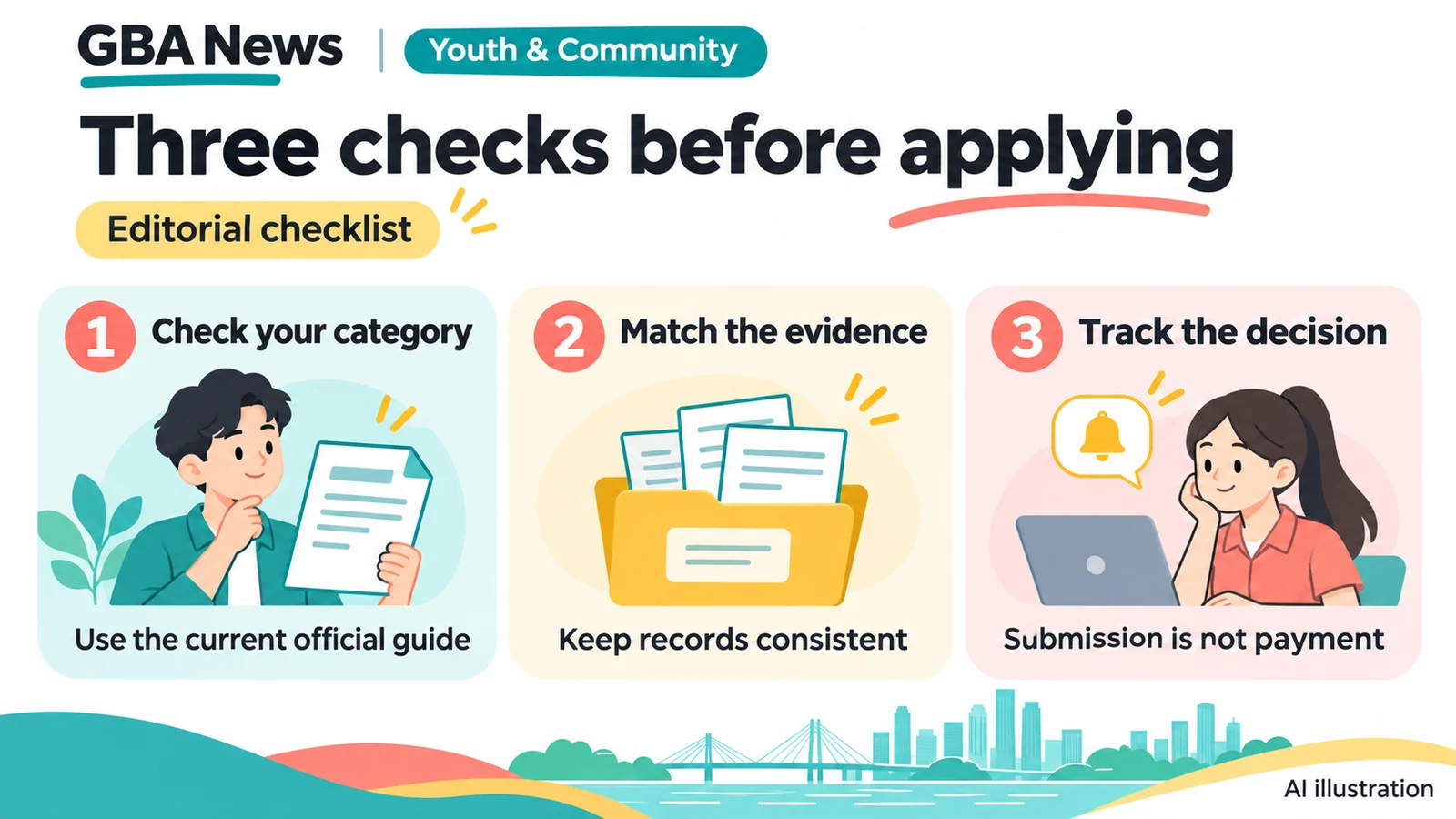
Keep the application and payment stages separate
Review and a five-working-day public notice stage precede payment. Monitor correction deadlines. GBA News has not accessed the linked individual and employer ZIP packs, or verified any applicant's award or payment.
Questions worth resolving before filing
For someone planning a move or a first job in Nansha, the practical question is not simply how large the advertised support looks. Identify which person or business would make the claim, which records are available, and which uncertainties need an answer from the administering office. Keep an application copy and distinguish a submission acknowledgement from an approval or a bank receipt. These are GBA News editorial suggestions, not additional official eligibility rules. Do not commit personal spending on the assumption that an application will succeed. A current open window is useful information; it is not a promise about an individual outcome.
Sources and image disclosure
Nansha HRSS: current 2026 application notice and guide (29 October 2026)
Nansha: underlying youth employment and entrepreneurship policy (issued 29 July 2026)
Nansha HRSS: earlier official policy summary (4 August 2026)
Sources checked on 5 November 2026. This is source-led reporting, not an on-site report. Images are AI-generated editorial illustrations of imagined scenes, not documentary event photographs.