
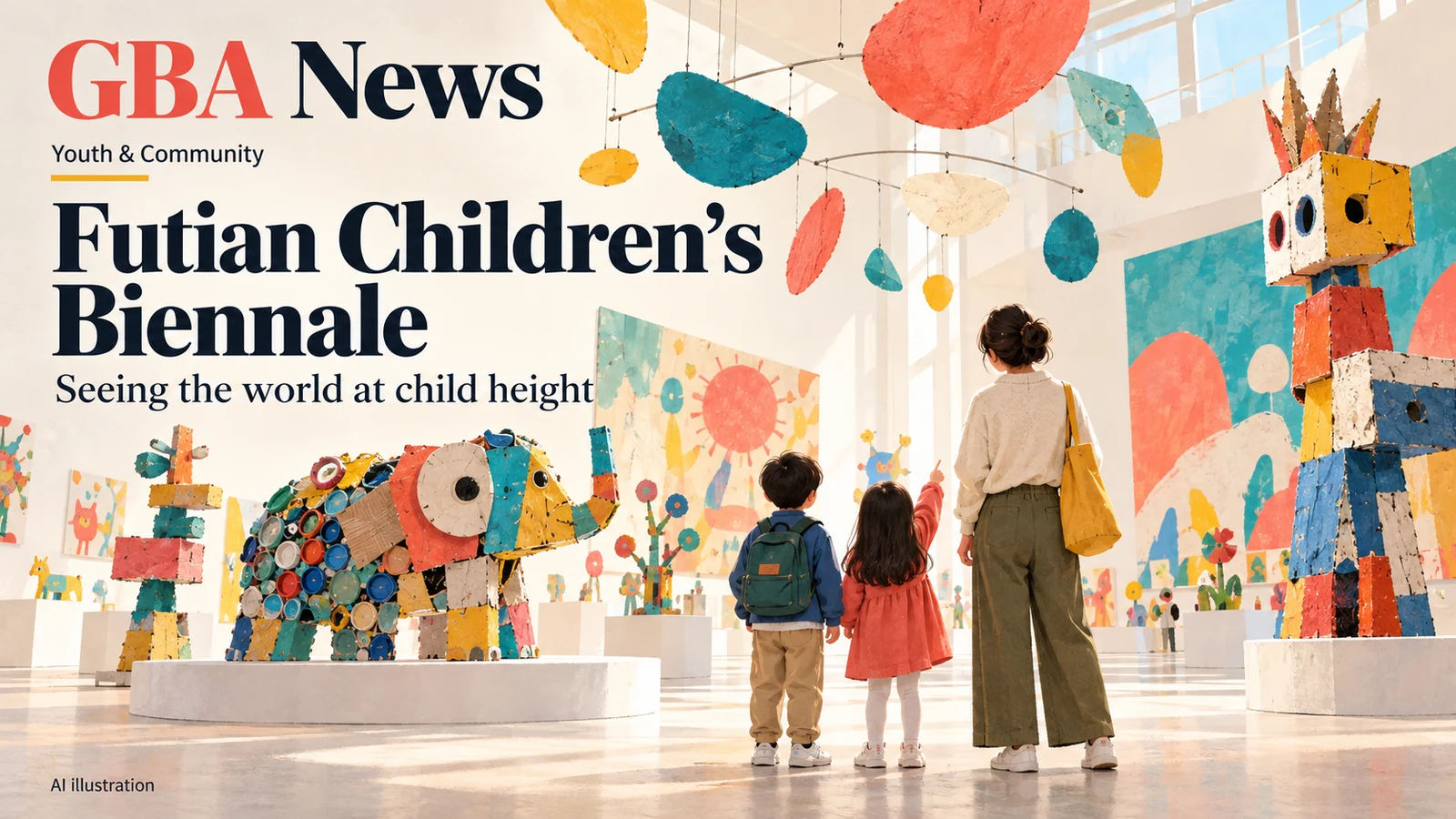
Futian's first Children's Biennale remains within its announced run at Shenzhen's Hua Art Museum, with free admission through 9 November. Projects from 13 kindergartens trace children's questions, experiments and changing ideas; daily visitor hours and booking arrangements remain unconfirmed in the reviewed source.
At a glance
- The announced exhibition runs from 21 October to 9 November 2026 at Hua Art Museum in Shenzhen, with free public admission.
- The opening ceremony was on 22 October; this is an ongoing exhibition, not a new opening or enrolment call.
- Thirteen kindergartens contributed projects developed through everyday inquiry, including repaired ceramics and a story told from different species' perspectives.
- The source reviewed on 30 October does not establish daily hours, booking requirements, remaining capacity or accessibility arrangements.
An ongoing exhibition, with children's inquiry at its centre
Families still have an announced exhibition window to explore Futian's first Children's Biennale: the district government's report lists a run from 21 October to 9 November at Hua Art Museum in Shenzhen, free to the public. Its opening ceremony took place on 22 October, rather than this weekend. Organised by the Futian preschool education development centre under the guidance of the district education bureau, the exhibition brings together 13 kindergartens. Its starting point is looking at the world from a child's height. The report describes everyday classroom investigations translated into a museum setting, preserving questions and creative processes rather than displaying finished objects alone.
Repaired ceramics make room for another attempt
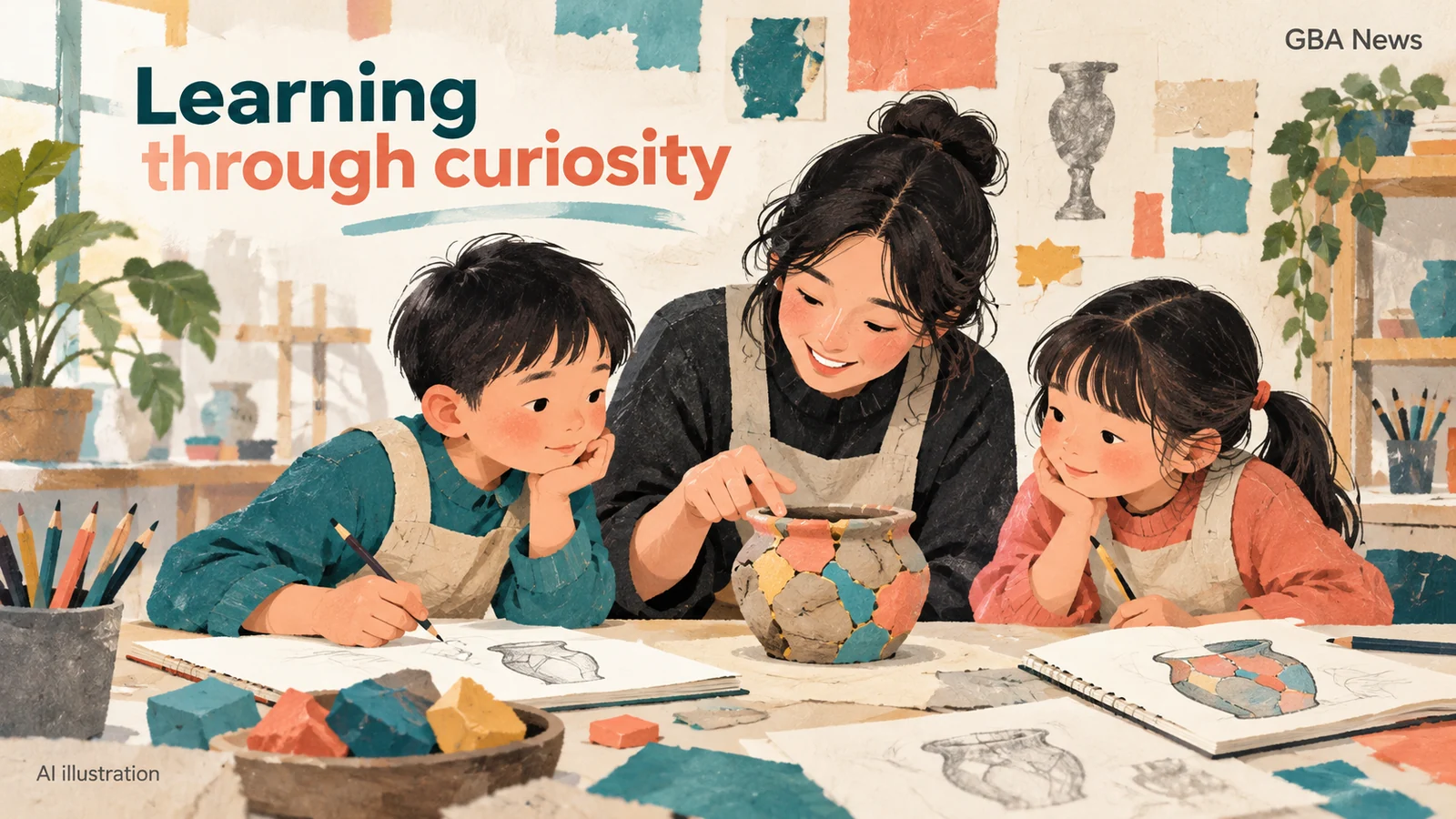
One example is the 'Museum of Failure' from Shenzhen No. 2 Kindergarten. The official account says children spent more than a year collecting moments when their investigations went wrong; the exhibition presents six groups of work. Broken and repaired ceramics are among the examples. The account describes children treating damage as a starting point for a different creation, rather than something that must be hidden. For visitors, this offers a concrete way to discuss revision: what happened to the material, what was kept and what changed? That question is GBA News learning guidance, not a claim that viewing the work produces a measured educational benefit.
A missing-fish story changes with the viewpoint
A project from Shenzhen Meilin Yicun Kindergarten begins with fish disappearing from a pond. According to the report, children initially blamed a cat, then checked surveillance footage and discovered visiting birds were taking the fish. The resulting button-operated animation lets viewers switch between the perspectives of fish, birds, the cat and children. The children supplied drawings and voices. Another project, from Shenzhen No. 5 Kindergarten, explores sharing a vegetable patch with birds: one half is protected by netting and the other left available for feeding. These accounts show how a practical classroom question can develop into competing explanations and choices, without requiring every visitor to reach one prescribed answer.
Learning processes, not a competition ranking
The district report attributes the wider exhibition to 13 projects selected from kindergarten investigations developed over roughly a year, rather than activities assembled only for the show. It also describes collaboration with museum professionals and artists. That background matters when looking at an object: the display is one point in a longer process involving observation, discussion and making. It does not establish that one participating kindergarten is better than another, or that the exhibition is an admissions assessment. Educators could use the documented examples to consider how their own displays record a child's original question and subsequent changes. This is editorial interpretation, not an announced teacher-training programme.
Let a family conversation follow the object
A manageable visit could begin with one work rather than a requirement to complete the whole gallery. Ask what the child notices before explaining the display, then consider what evidence might change a first impression. The missing-fish account provides a useful example of revising an assumption after checking information. With repaired ceramics, the conversation might concern a second attempt rather than who made the neatest object. These are optional GBA News suggestions, not advertised workshops or instructions from the museum. Follow venue rules about interaction and photography, and avoid publishing another child's name, school or face without appropriate permission.
Check visitor arrangements before travelling
The Futian government article was published on 23 October and its text was reopened for the 30 October source review. It supports the venue, free admission and announced closing date, but gives no detailed daily opening hours, closure-day arrangements, booking procedure, remaining capacity or accessibility information. An exhibition end date is not a guarantee that entry is possible at any chosen hour. Check current museum information before travelling, especially for a group visit or particular access needs. There is no new application deadline to report. The useful opportunity is to visit an exhibition already under way, subject to current visitor arrangements, not to apply for a school place or competition.
Sources and image disclosure
Futian District Government: first Children's Biennale opens
Sources were reviewed on 30 October 2026. Announcement, event and application dates are distinct from this article’s actual publication date. Practical interpretation is editorial analysis, not an official promise. The cover and contextual image are AI-generated editorial illustrations, not documentary photographs.