
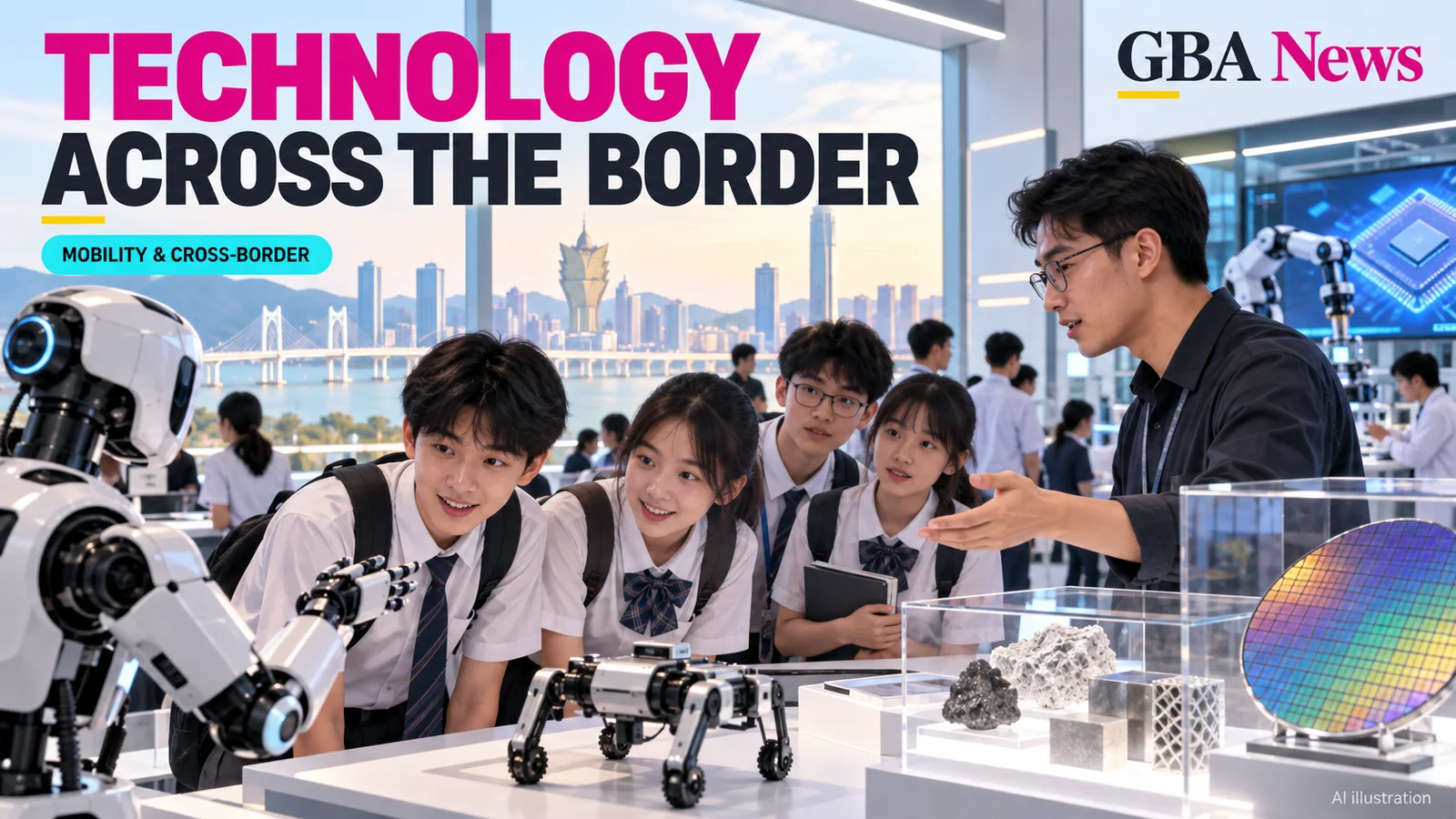
A new school year of cross-border technology visits has begun for Macao secondary students. The first 2026–27 Meet Technology — Visit Hengqin group travelled through Hengqin Port on 22 September for a one-day programme introducing the cooperation zone’s technology industries and working environments.
The first group included 73 students. They visited the Hengqin planning exhibition, innovation displays and companies working in fields such as artificial intelligence, information technology, new materials and semiconductors. Macao government report on the first 2026–27 visit.
At a glance
- The first visit of the 2026–27 school year took place on 22 September.
- Seventy-three Macao secondary students joined the first group.
- The itinerary included planning, innovation and company visits in Hengqin.
- The programme will continue in batches during the school year, but the public report does not provide a direct individual application route.
What students saw
The itinerary moved from a broad view of Hengqin’s development to specific technology workplaces. Students heard about policy support, the development of information-technology industries and examples of technologies being used in practice. In company research spaces, they observed product-development processes and discussed study choices, employment and cooperation between Macao and Hengqin.
That progression is useful for career learning. A planning exhibition can explain why an industry cluster is being developed, while a company visit can show the work, tools and skills inside it. Neither, however, replaces independent information about a university course, occupation or employer. Students should compare what they observed with current admission requirements and job descriptions.
A continuing cross-border programme
The initiative is jointly organised by the Cooperation Zone’s talent-development and social-security bureau and Macao’s Education and Youth Development Bureau. The official report says groups will continue to visit during the school year, with activities focused on science and technology education and the practical development of Macao–Hengqin integration.
Since the programme began, ten groups involving about 500 Macao secondary students have joined Meet Technology visits. More broadly, the Cooperation Zone’s Macao youth exchange programme has organised nearly 450 visits involving more than 33,800 Macao residents of different ages and backgrounds.
Those cumulative figures describe participation across organised activities. They should not be interpreted as university places, jobs or entrepreneurship funding. A school visit is an exposure and learning opportunity; any later admission, internship or employment route has its own criteria and selection.
Questions students can take back to school
After a company visit, students can turn impressions into research. What roles did they observe? Which subjects and technical skills do those roles require? What does a normal entry route look like? Which parts of the work were demonstrated, and which remained unseen? A short reflection using these questions is more useful than simply deciding that a sector looked exciting.
Students interested in AI or semiconductors should identify the difference between research, product engineering, operations and commercial roles. Those pathways may require different combinations of mathematics, computing, laboratory practice, communication and business knowledge. The purpose of an early visit is not to lock in a career, but to make the next educational question more specific.
Access and safeguarding
The public report describes a school-group programme and does not show a form for individual students to register directly. Interested families should ask the student’s school or the official education authority whether and how future groups are selected. Do not rely on an unofficial agent claiming guaranteed access.
For any cross-border school activity, families should check the organiser, transport and supervision arrangements, documents required for border crossing, consent procedures and emergency contact information. Schools should give participants a clear itinerary and explain how photographs or personal information will be handled.
Why this matters for regional development
Hengqin’s role in Macao’s development is often discussed through policy and infrastructure. Student visits add a human layer by showing young people the industries, workplaces and study questions behind that strategy. Repeated programmes can also help educators understand where classroom learning connects with the region’s changing economy.
The value will depend on quality, access and follow-up. A visit becomes stronger when students can reflect, ask further questions and find verified next steps. The start of the 2026–27 series is a real milestone, but it is not an open call or a promised career outcome.
Students should keep a simple visit record: the organisation, technology observed, one skill used in the workplace, one question left unanswered and the official source to consult next. This turns a one-day tour into a more durable learning exercise.