

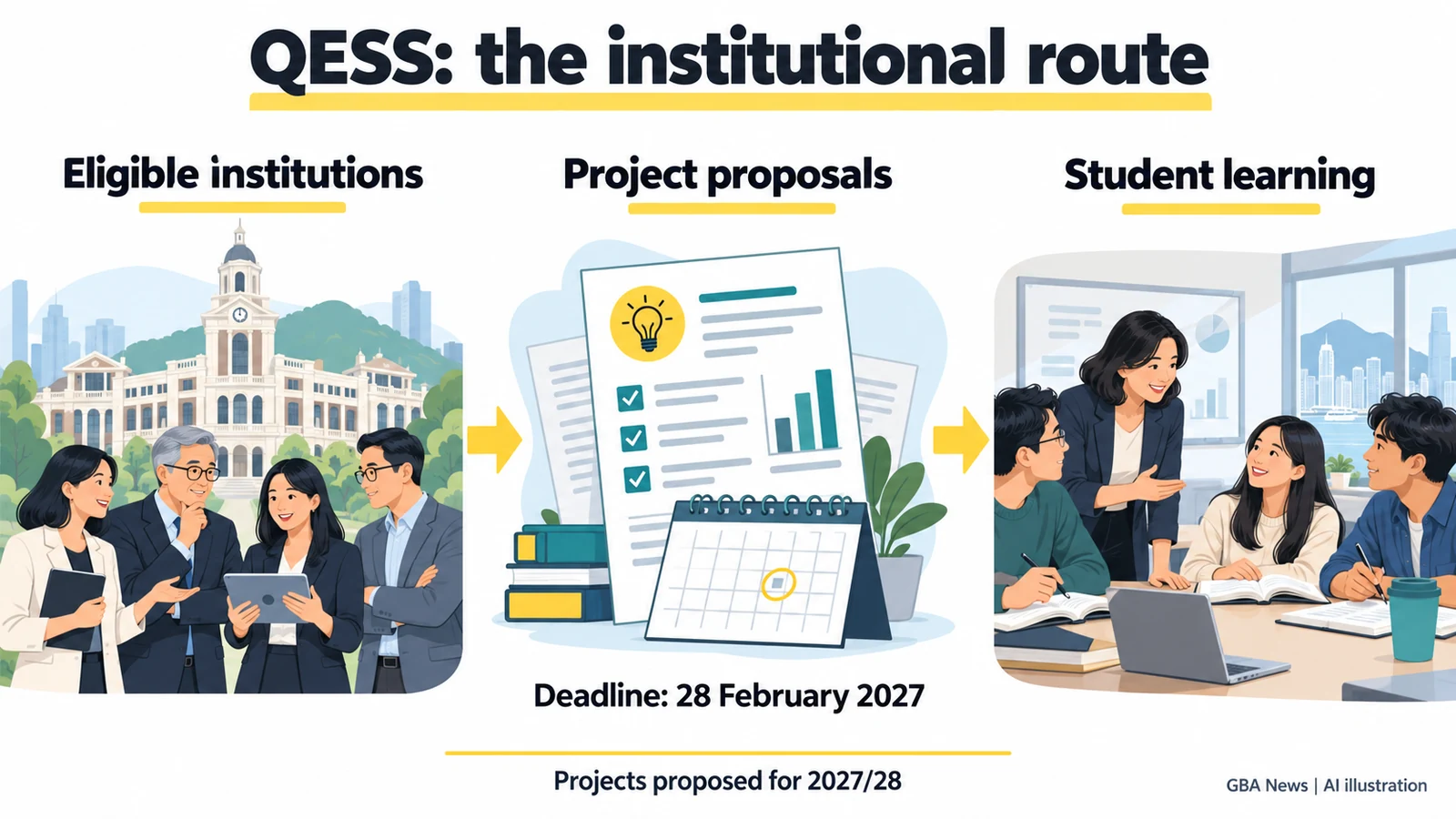
Eligible institutions have until 28 February 2027 to seek Quality Enhancement Support Scheme funding for projects proposed to start in 2027/28. The round covers learning, student support and industrial attachments, not personal grants.
At a glance
- The 2026/27 QESS round opened on 26 October 2026, with an institutional application deadline of 28 February 2027.
- Proposals concern projects intended to launch in the 2027/28 academic year; submission is not project approval.
- Eligible non-profit institutions and related bodies apply, not individual students seeking cash or a placement.
- Three categories cover collaborative themes, open-ended learning improvements and industrial attachment projects.
An institutional deadline, not student enrolment
Hong Kong's Education Bureau invited applications on 26 October for the 2026/27 Quality Enhancement Support Scheme (QESS), part of the Self-financing Post-secondary Education Fund. The deadline is 28 February 2027, for projects proposed to launch in the 2027/28 academic year. These dates distinguish institutional submission from intended delivery. Neither is a deadline for students to enrol for a scholarship or internship. The announcement invites proposals rather than announcing this round's successful projects.
Which organisations can submit proposals
Eligible applicants include non-profit-making education institutions offering full-time, locally accredited self-financing sub-degree or bachelor's degree programmes, including top-up degrees. Related bodies, such as federations of those institutions and quality assurance agencies, may also apply. The bureau says applications will be considered by the Sub-committee on Support Measures under the Committee on Self-financing Post-secondary Education. This is therefore a route for organisations to develop teaching and learning, not a general application channel for any education business or individual. Staff preparing a proposal should consult the official QESS guidance linked from the announcement for the application procedures.
Collaboration and classroom improvements
QESS accepts theme-based, open-ended and industrial attachment projects. For theme-based work, applicants can set their own themes, but the projects must be planned and undertaken by more than one eligible institution. The stated purpose is collaboration with benefits extending across the sector. Open-ended proposals cover improving the student learning experience and language proficiency, teaching methods and assessment strategies, and quality assurance. They can also strengthen student support and careers guidance, including support for non-Chinese speaking students and students with special educational needs. These are funding areas, not confirmation that a particular service is already operating at a named campus.
What industrial attachment proposals can cover
The attachment category allows proposals to incorporate quality-assured work-based learning and assessment into curricula through industry partnerships. Institutions can also seek more attachment opportunities within or outside Hong Kong, improve support for students already on attachments, or organise relevant visits and short training or courses. That scope matters because work-related learning involves more than finding a host employer: the announcement explicitly includes assessment and institutional support. It does not identify a new placement list, participating employers, student selection arrangements or a separate cross-border recruitment round. Any eventual opportunity requires its own project and participant details.
Earlier approvals show the range, not this round's result
The bureau reports that seven of 30 applications in the 2025/26 round were approved, with about HK$23 million earmarked. Their themes included an artificial intelligence-supported Cantonese listening and speaking assistant, an AI-powered assessment platform, and a knowledge transfer and entrepreneurship centre for humanities, arts and social sciences. Other themes involved values and ethics education, virtual reality training for nasogastric tube procedures and laboratory emergencies, and cross-cultural education and industry collaboration. These are examples from an earlier funding decision. Approval and earmarked funding do not establish that a tool has launched, achieved its intended benefits or become available to every student.
Questions students can usefully ask
For students, the practical question is what an eventual project changes in their own learning. As editorial guidance, useful questions include which learners it serves, how a placement relates to their course, who provides support and how learning is assessed. Those questions follow the areas described in the announcement; they are not extra QESS eligibility rules. A proposed attachment outside Hong Kong also should not be treated as settled travel, work permission or financial support. Ask the institution for the approved project's arrangements when available, rather than treating a broad funding category as an individual entitlement.
Source dates and the next decision
The bureau's 26 October announcement was rechecked on 30 October. Institutions should consult its linked QESS guidance for procedures and subsequent amendments before submission. Application, approval and student-facing delivery are separate stages. The regional relevance is potential improvement in Hong Kong learning and work-related support, not a personal application route for residents elsewhere in the Greater Bay Area.
Sources and image disclosure
Sources were reviewed on 30 October 2026. Announcement, event and application dates are distinct from this article’s actual publication date. Practical interpretation is editorial analysis, not an official promise. The cover and contextual image are AI-generated editorial illustrations, not documentary photographs.