
A Guangzhou meeting has put closer links between AI research and industry on the Hong Kong-Guangdong co-operation agenda. For young technology teams, the practical question is how a proposed direction becomes an accessible project.
At a glance
- The 21st Hong Kong/Guangdong informatisation expert-group meeting took place in Guangzhou on 21 October.
- Hong Kong suggested making AI-to-industry links a focus of next year's co-operation.
- The proposal builds on exchanges involving Hong Kong's AI research institute and Guangzhou's Pazhou Lab.
- The announcement is a co-operation update, not an open call for grants or internships.
A next-year proposal, not a new funding round
At the meeting, Acting Commissioner for Digital Policy Daniel Cheung proposed further AI-and-industry collaboration for the coming year. The discussion followed exchanges involving the Hong Kong Artificial Intelligence Research and Development Institute and Pazhou Lab. The government release also described a related morning conference on AI, software, cloud and ICT applications, attended by nearly 500 participants.
Why the research-to-industry link matters
For a young engineer, a promising demonstration and a usable industrial tool are different achievements. An application needs a defined customer problem, suitable data, a way to test performance and someone responsible when it fails. GBA News's reading is that research exchanges become most useful to smaller teams when those practical requirements are visible. A broad co-operation headline does not yet tell a founder which organisation will accept a proposal, who will own resulting intellectual property or whether testing facilities will be available.
A broader cross-border working agenda
Officials reviewed progress and future work across smart-city development, cross-border e-commerce, customs-clearance technology, innovation and telecommunications. The range matters as context: AI applications do not operate separately from the movement of goods, information and services. For readers comparing opportunities across the Greater Bay Area, it is worth identifying the specific operational problem behind a proposed partnership before treating every regional technology announcement as the same kind of opportunity.
What young teams can prepare now
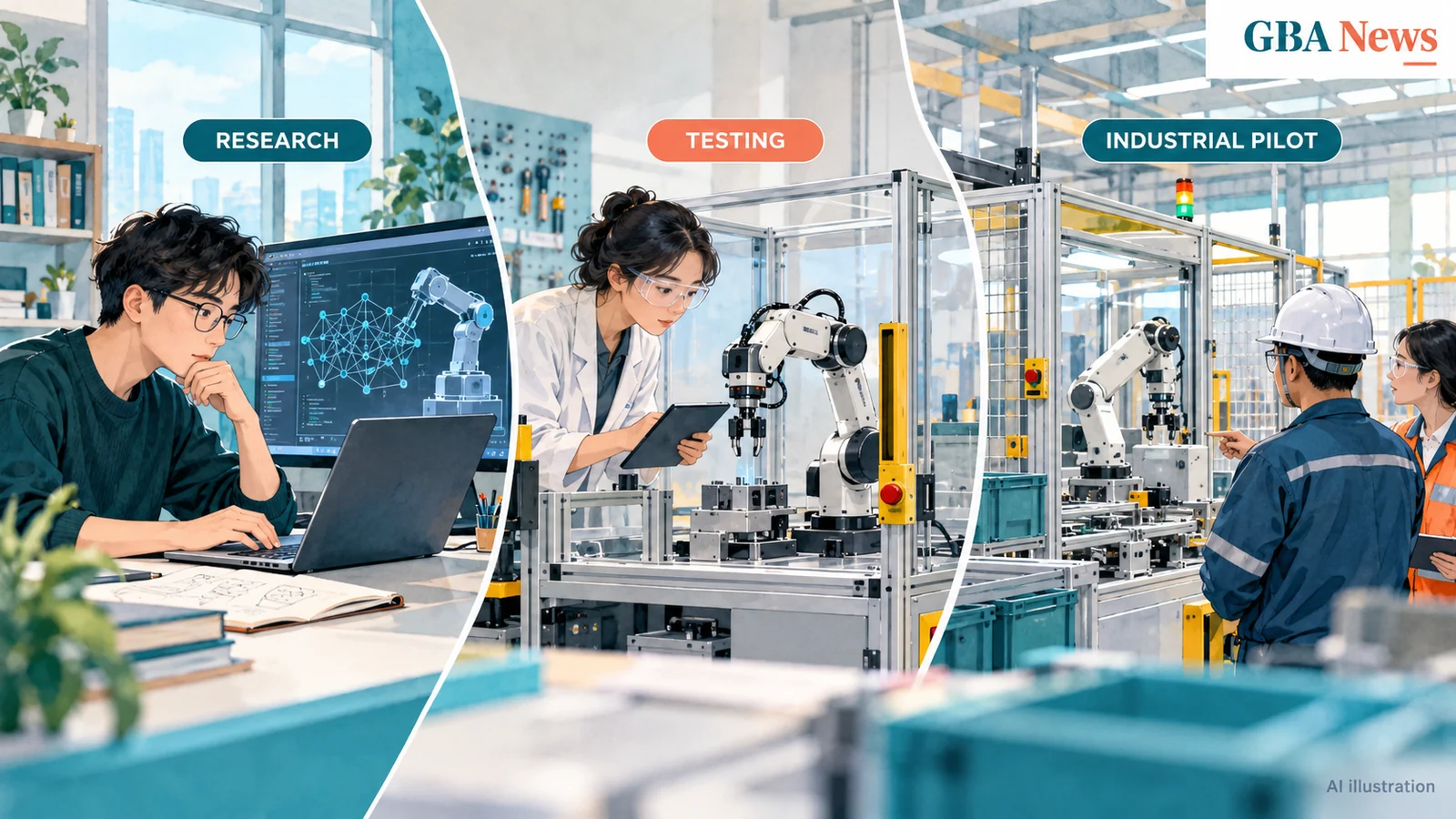
Preparation need not mean committing money to an unannounced scheme. A useful starting document would state the intended industrial user, the current limitation, the proposed AI function and a measurable test of improvement. It should distinguish an existing prototype from work still to be done. Students seeking experience could apply the same discipline to a portfolio: show the task, the evaluation method and what did not work, rather than describing a tool only as an AI platform.
What to watch in the follow-through
The next meaningful evidence would be named projects, published participation routes or concrete arrangements for testing and collaboration. Those are editorial checkpoints, not commitments reported from this meeting. Readers should look for an identifiable programme owner and written terms before assuming that a regional co-operation discussion offers an immediately available placement, contract or research budget. A subsequent announcement may answer those questions; this release does not substitute for one.
The limits of this announcement
No grant application window, internship intake or general invitation to submit projects is established by the linked release. The proposal is dated 21 October; this report is published using its actual website publication time. For youth and regional-development readers, the news is the proposed direction of co-operation. Whether it creates an accessible opportunity for a particular person or business will depend on separately published details.
Sources and image disclosure
Reporting is based on the linked official sources, with announcement dates and event dates distinguished in the article. Practical interpretation is editorial analysis, not an additional official promise. Sources were reviewed on 22 October 2026. The cover and contextual image are AI-generated editorial illustrations, not documentary photographs.