
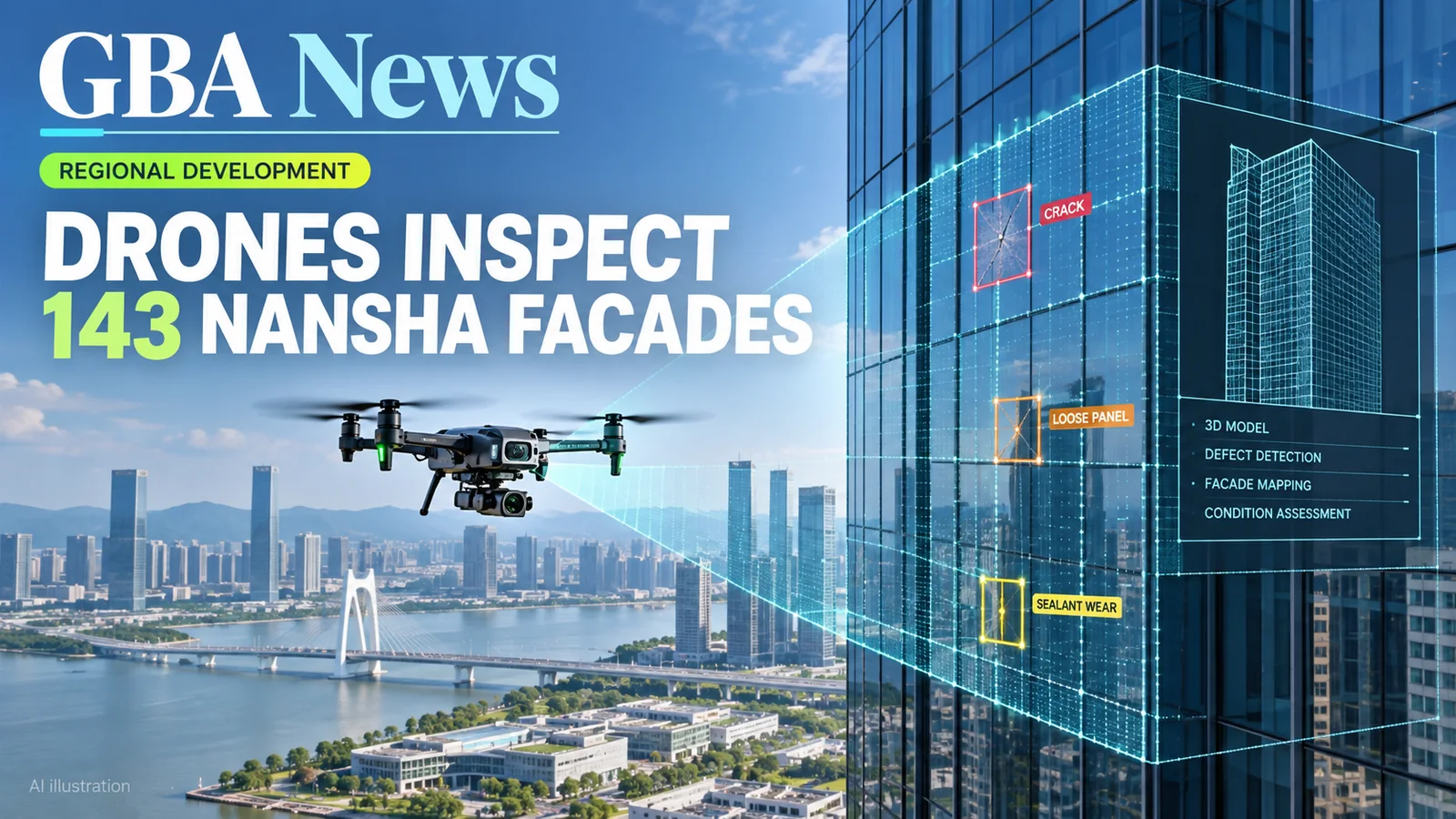
Nansha has completed drone, AI and 3D-model inspections of 143 buildings with glass curtain walls, identifying thousands of potential maintenance points.
At a glance
- The programme covered 143 glass-curtain-wall buildings.
- It identified 423 glass damage points and 2,814 seal-strip damage or detachment points.
- The project passed completion acceptance.
From manual access to aerial inspection
Glass facades can be difficult and costly to inspect from the ground or by rope access alone. Nansha's programme combined drone capture, artificial intelligence and three-dimensional modelling to build a more systematic view of exterior conditions. Completion acceptance confirms the project milestone, not that every identified defect has already been repaired.
What the figures show
The official report lists 423 glass damage points and 2,814 seal-strip damage or detachment points across the surveyed stock. These are inspection findings that require professional assessment and prioritisation. A detected point is not automatically an immediate structural failure, and the authority's maintenance process remains the source for any building-specific risk or action.
Why data quality matters
Computer vision can help find repetitive patterns across large image sets, but results depend on capture conditions, model performance and human review. Building owners need traceable images, location references and follow-up inspections. A technology demonstration should be judged by verified detection quality, reduced risk and completed maintenance rather than the novelty of using drones.
A regional maintenance challenge
Rapid urban development across the GBA has produced a large stock of high-rise buildings and complex facades. Nansha's approach may be relevant elsewhere, but local building codes, data rules, flight permissions and procurement requirements differ. A completed district project does not create automatic authority to fly or inspect in another city.
What owners and residents should do
Residents should report visible damage through the responsible property or government channel rather than attempting close inspection themselves. Owners considering similar services should verify aviation permissions, insurance, data handling, professional qualifications and the scope of the final report. Repair decisions should remain with authorised professionals and the relevant building-safety regime.
How to read this development
Regional development becomes meaningful when transport, housing, finance, land and public services move in a coordinated sequence. A launch, inspection or policy direction is not the same as an operational service or funded entitlement. GBA News separates the source date, event or policy date and actual publication date so an older official development is not presented as a new event.
The wider Greater Bay Area context
A Greater Bay Area lens should not flatten different cities into one system. Hong Kong and Macao retain their own legal and immigration arrangements, while mainland GBA cities operate through their respective provincial and municipal authorities. Readers should separate a regional signal from the rule applying to a particular journey, application, employer or transaction. Compare the official owner, effective date, eligible location and evidence required before acting. Where a notice points to future implementation, the next verification step is the named operating document, registration channel or service timetable rather than an assumption that access is already available across all 9+2 cities.
A practical next step
Identify the exact project owner and verify whether the milestone is a study, funding approval, construction start or public opening. Compare current transport, cost and service details before making a relocation or investment decision.
Our source standard
GBA News reviewed the named official publication and kept its figures, dates and qualifications attached to that source. We have not converted an announced plan into an open application, a selected cohort into a payment, or an organiser's result into an independent guarantee. Public arrangements can change after publication, so readers should check the authority's current page before spending money, submitting personal information or beginning a journey.
About the cover
The cover is an AI-generated editorial illustration, not documentary evidence. It uses an article-specific object, infrastructure element or relevant scene rather than defaulting to a generic youth portrait. Reporting authority comes only from the linked primary source and attributed facts.
Official source
Read the Nansha completes drone and AI inspection of glass curtain wall buildings. The linked authority remains the source of record for operational changes, deadlines and eligibility.