
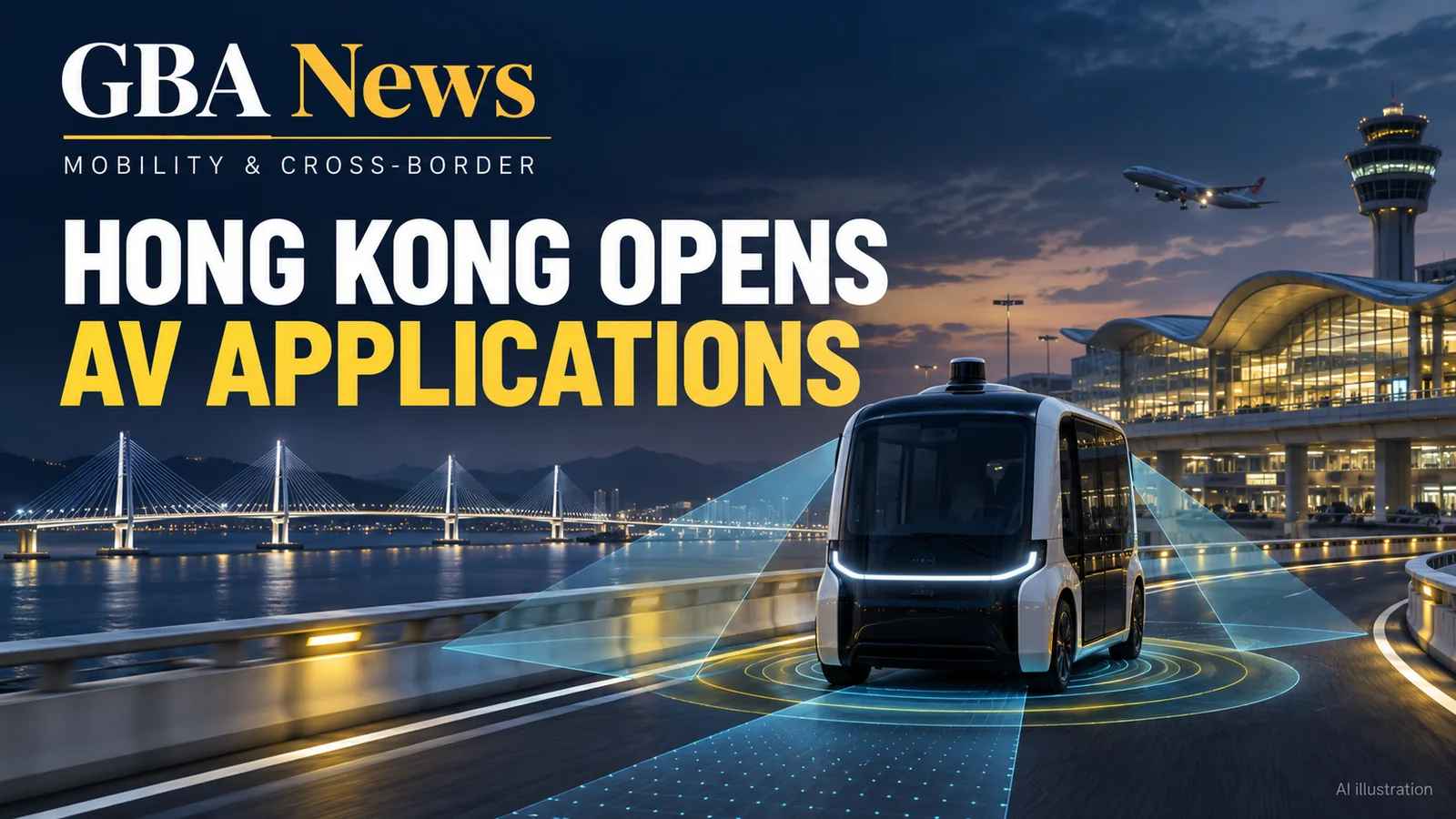
Hong Kong's Transport Department plans to accept applications for commercial autonomous-vehicle operations within 2026 as trials continue on Airport Island and at the Hong Kong Port.
At a glance
- Commercial-operation applications are planned within 2026.
- Trials are under way on Airport Island and at the Hong Kong-Zhuhai-Macao Bridge Hong Kong Port.
- The Airportcity Link and an air-rail intermodal service are also part of the wider mobility plan.
From trial to application framework
The planned acceptance of commercial-operation applications is a regulatory step, not confirmation that autonomous vehicles are already available as a general public service. Applicants will need to meet the eventual technical and operational requirements. The public should wait for approved routes, operators, passenger rules and launch dates before planning a journey around the service.
Why the airport and bridge-port setting matters
Airport Island and the Hong Kong Port of the Hong Kong-Zhuhai-Macao Bridge offer bounded environments where routes and operating conditions can be studied. They are also important cross-border gateways. Safety evidence from a controlled route cannot automatically be applied to every urban street, so expansion should remain tied to the approved operating domain.
The Airportcity Link
The broader plan includes the Airportcity Link, intended to improve movement between airport-related destinations. Integration matters because an autonomous segment is only useful when passengers can connect to terminals, public transport and border services. Luggage handling, accessibility, disruption procedures and human assistance are part of the passenger experience.
Air-rail integration in 2027
The official announcement also refers to an Air-Rail Intermodal Service connecting Hong Kong West Kowloon high-speed rail station with the Airport Express in Kowloon, scheduled for the second quarter of 2027. That date is forward-looking. Travellers should not treat the service as available until the operator publishes confirmed arrangements.
What to watch next
The next evidence should include application criteria, approved operators, vehicle oversight, data governance, incident reporting and passenger information. Autonomous transport may create roles in engineering, fleet operations and safety assurance, but a policy announcement is not a current job offer. Students should follow named employers and accredited training routes.
How to read this development
Cross-border mobility depends on operating dates, checkpoints, documents, booking rules and real-time conditions. Travellers should confirm the latest authority notice before departure. GBA News separates the source date, event or policy date and actual publication date so an older official development is not presented as a new event.
The wider Greater Bay Area context
A Greater Bay Area lens should not flatten different cities into one system. Hong Kong and Macao retain their own legal and immigration arrangements, while mainland GBA cities operate through their respective provincial and municipal authorities. Readers should separate a regional signal from the rule applying to a particular journey, application, employer or transaction. Compare the official owner, effective date, eligible location and evidence required before acting. Where a notice points to future implementation, the next verification step is the named operating document, registration channel or service timetable rather than an assumption that access is already available across all 9+2 cities.
A practical next step
Build the journey end to end, including departure point, operating period, checkpoint, onward transport and return. Allow a buffer during holidays and separate transport availability from each traveller's immigration eligibility.
Our source standard
GBA News reviewed the named official publication and kept its figures, dates and qualifications attached to that source. We have not converted an announced plan into an open application, a selected cohort into a payment, or an organiser's result into an independent guarantee. Public arrangements can change after publication, so readers should check the authority's current page before spending money, submitting personal information or beginning a journey.
About the cover
The cover is an AI-generated editorial illustration, not documentary evidence. It uses an article-specific object, infrastructure element or relevant scene rather than defaulting to a generic youth portrait. Reporting authority comes only from the linked primary source and attributed facts.
Official source
Read the Hong Kong advances smart mobility and autonomous transport. The linked authority remains the source of record for operational changes, deadlines and eligibility.