
Shenzhen's market regulator has reported the release of standards roadmaps for AI glasses, HarmonyOS industrial applications and megawatt ultra-fast charging. The report was published on 20 October, following an event held in Hetao on 13 October.
At a glance
- Shenzhen's market regulator published its event report on 20 October 2026; the Hetao event took place on 13 October.
- Standards-system implementation roadmaps covered AI glasses, HarmonyOS industrial applications and megawatt ultra-fast charging.
- The event also released a white paper on standardisation for organisational governance of AI.
- A Hetao work platform was approved to review Bay Area Standards; the report does not announce universal product certification.
An October report on an earlier Hetao event
Shenzhen's Administration for Market Regulation has outlined standards work aimed at connecting emerging technology with industrial development. Its report, published at 16:36 on 20 October, describes a World Standards Day event held on 13 October at the Hetao Science and Innovation Centre. Those dates are different: this is a newly published account of an earlier event, not a claim that the gathering took place today. Government, international standards organisations, research bodies and technology businesses participated in the programme.
Three technology roadmaps and an AI governance paper
The event released standards-system implementation roadmaps covering AI glasses, HarmonyOS industrial applications and megawatt ultra-fast charging. It also introduced a standardisation white paper on organisational governance of artificial intelligence, addressing governance, risk and ethics. These are distinct strands of work. A roadmap can indicate how a field's standards are being organised; a governance paper addresses organisational questions. Neither description should be shortened into a claim that every device in the category has passed a test, or that the event itself created a new mandatory rule for every manufacturer.
A Greater Bay Area platform at Hetao
The regulator said Guangdong's market-regulation authority had approved the Hetao work platform of a Greater Bay Area standardisation research centre to review Bay Area Standards. This gives the announcement a regional dimension beyond a single product category. The report also described standards organisations operating in Hetao and the role of international cooperation. It does not, however, establish that all standards discussed at the event have identical legal effect in Hong Kong, Macao and mainland cities. Businesses still need to identify the document, its applicable jurisdiction and its status.
An editorial checklist for AI glasses teams
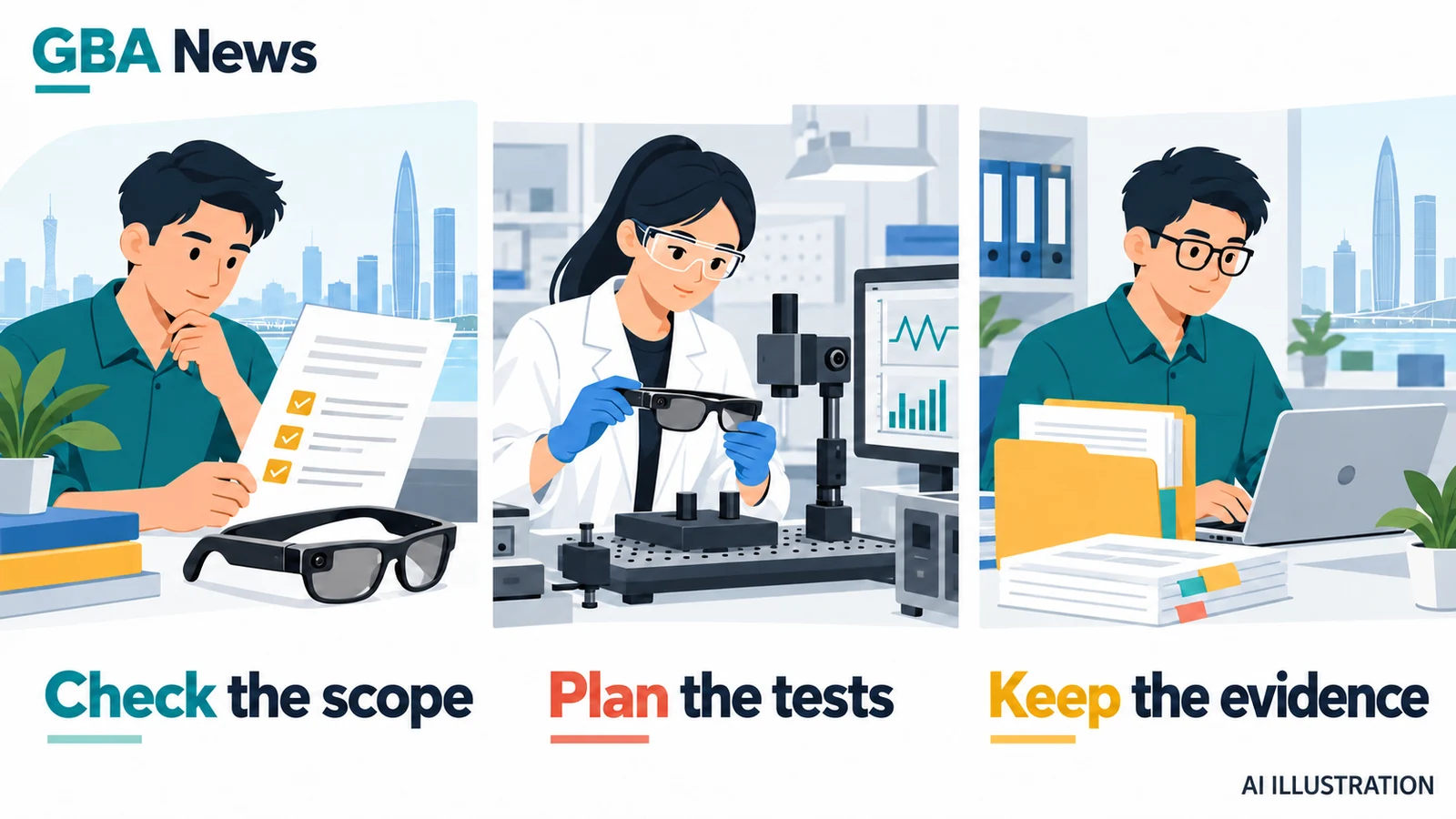
For a young hardware team, the practical starting point is to locate the actual roadmap or relevant standard and check its scope, edition and intended use. Then distinguish a development plan from a published technical requirement, a testing report and any certification that a particular market requires. Keeping a clear record of the product configuration and the evidence behind a claim can make later conversations with laboratories and partners more precise. This is editorial interpretation for founders, not a testing procedure issued by Shenzhen in the linked report or a promise that following three steps establishes compliance.
Where young engineers fit in
The event report also highlighted a youth standards programme that Shenzhen has operated for ten consecutive years, combining annual selection, systematic training and follow-up development. It noted that four participants had become IEC Young Expert Leaders. That history illustrates a route into standards work, but it is not evidence that a new intake is currently accepting applications. Students interested in this field can investigate technical writing, test documentation and participation rules at the relevant organisation; readers should confirm a current recruitment notice before treating an opportunity as open.
What remains to be checked
Teams planning a product launch should obtain the underlying documents and ask which provisions apply to their specific product and destination market. This news report is not a substitute for a laboratory assessment or legal compliance review. The source records roadmaps, a white paper and platform development; it does not publish a blanket approval for AI glasses, guarantee cross-border market access or announce a new grant application deadline. The distinction between a 13 October event and its 20 October publication is retained throughout.
Sources and image disclosure
Shenzhen World Standards Day event: standards connecting the world (Chinese)
Reporting is based on the linked official sources, with announcement dates and event dates distinguished in the article. Practical interpretation is editorial analysis, not an additional official promise. Sources were reviewed on 21 October 2026. The cover and contextual image are AI-generated editorial illustrations, not documentary photographs.